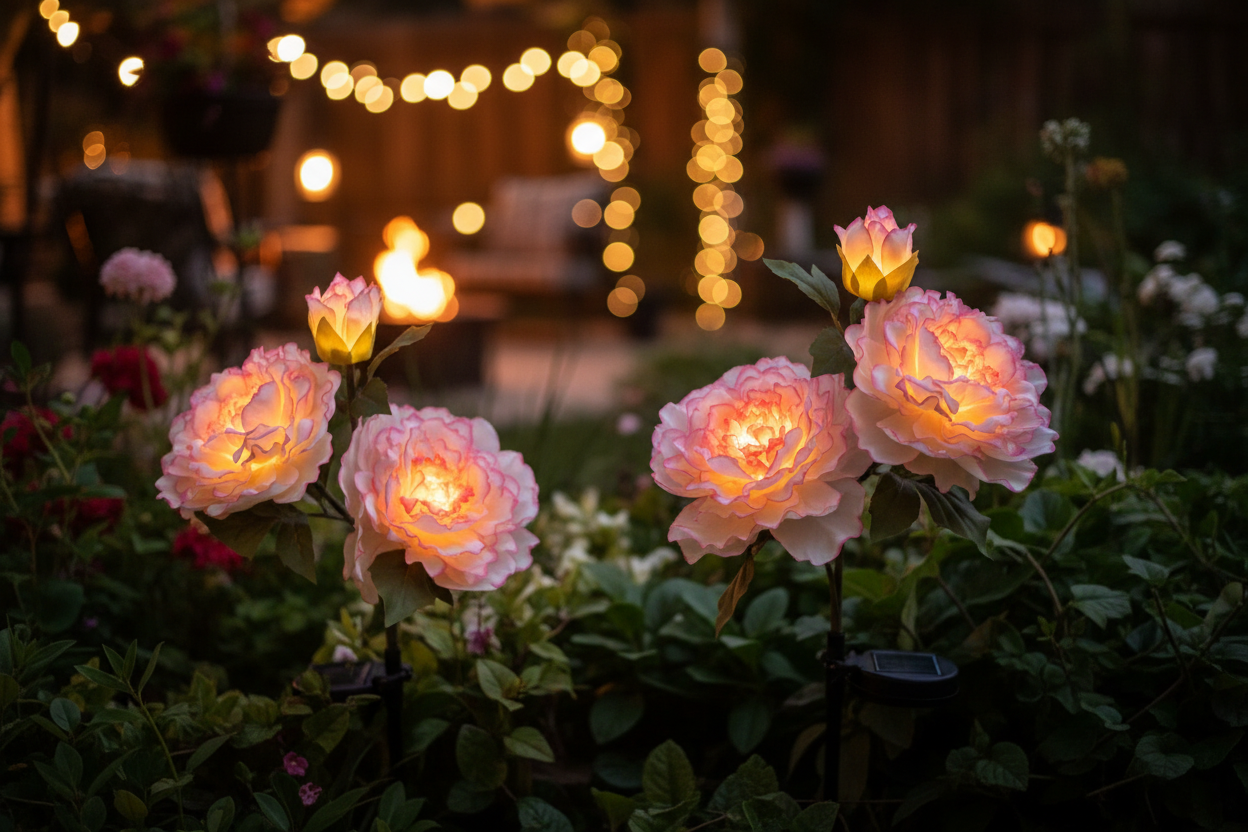
It started with a problem most homeowners know all too well: a beautiful backyard that looked completely dead after sunset.
My name is Sarah, and I live in a suburb just outside of Portland, Oregon. We bought our house three years ago specifically for the yard — a generous half-acre with mature oak trees, a stone pathway winding through the flower beds, and a small courtyard patio where we'd always imagined hosting summer dinners. The problem? The moment the sun went down, all of that beauty disappeared into darkness. We had one weak porch light that barely reached the back steps, and that was it.
I'd been putting off outdoor lighting for two reasons: the cost of hiring an electrician to run wiring, and the sheer hassle of it all. My husband kept saying we'd "get to it eventually," which in homeowner language means never. Then last spring, a neighbor two streets over had her garden lit up like something out of a magazine — warm golden light washing up the trunks of her birch trees, the pathway glowing softly all the way to her front door. I had to ask what she used.
The Solar Switch
She pointed me to solar spotlights — specifically a set with 18 LED lamp beads per unit, staked directly into the ground with no wiring required. I was skeptical. I'd tried cheap solar path lights before and they'd always disappointed: dim, unreliable, dead by 10pm. But she insisted these were different, and honestly, her garden was the proof.
I ordered a 4-Pack to start, figuring I'd test them on the oak trees flanking our back patio. Installation took maybe twenty minutes total. Each light has a ground stake you push into the soil, an adjustable head you angle toward whatever you want to illuminate, and a small solar panel on top. No tools required beyond your hands. I set them up on a Saturday afternoon, and by that evening they were already charged enough to run.
The difference was immediate and honestly a little emotional. Those oak trees — which I'd walked past a thousand times without really seeing — suddenly looked architectural. The light caught the texture of the bark, threw long shadows across the lawn, and made the whole yard feel intentional and designed rather than just... a yard.
Scaling Up for the Courtyard
Within two weeks I'd ordered a second set — this time the 36 lamp bead version in a 6-Pack — for the courtyard area and the stone pathway. The 36-bead units are noticeably brighter, which made sense for the open patio space where we actually spend time in the evenings. The 18-bead lights work perfectly for accent and atmosphere; the 36-bead ones are better when you need actual functional light to see where you're walking or to illuminate a seating area.
By midsummer, we were eating dinner outside three or four nights a week. Friends who came over kept asking if we'd had professional lighting installed. When I told them it was all solar and I'd done it myself in an afternoon, the reactions were priceless.
What Actually Holds Up Over Time
Now that I've had these lights through a full Pacific Northwest winter — which means months of grey skies, heavy rain, and temperatures that dip into the low 30s Fahrenheit — I can speak to durability. They're weather resistant, and they've held up without any issues. A few nights of heavy rain didn't affect performance. The solar panels kept charging even on overcast days, though runtime was shorter on the cloudiest weeks, which is just physics.
The adjustable angle has been more useful than I expected. As the seasons changed and the sun's angle shifted, I was able to reposition the solar panels to keep them optimally charged. And when I replanted some of the flower beds in autumn, I just pulled the stakes out, moved them, and repositioned the light heads. No rewiring, no calling anyone, no problem.
The Honest Tradeoffs
I want to be fair here, because no product is perfect. Solar lights are dependent on sunlight, which means spots that are heavily shaded during the day will underperform. I have one corner of the yard under a dense canopy where the lights barely last past midnight — that's just the reality of the technology. For those spots, I've accepted that traditional wired lighting would be the better solution.
Also, if you're expecting the kind of blazing brightness you'd get from a 100-watt floodlight, solar spotlights aren't that. They're warm, atmospheric, and genuinely beautiful — but they're accent lighting, not stadium lighting. Once I understood that distinction, my expectations aligned perfectly with what I was getting.
Who These Are Really For
After talking to several neighbors who've now made the same switch, I'd say solar garden spotlights are ideal for anyone who wants to meaningfully improve their outdoor space without a major project. Renters who can't run permanent wiring. Homeowners who want to test a lighting layout before committing to hardwired installation. People who care about energy costs and don't want to add to their electricity bill. Anyone who's been putting off outdoor lighting because it seemed too complicated.
The packs ranging from 2 to 8 units mean you can start small and expand gradually, which is exactly what I did. Start with a 2-Pack on your most important feature — a tree, a garden bed, a pathway entrance — see how you like it, then build from there.
Our backyard is now one of my favorite places to be after dark. That's not something I could have said two years ago. Sometimes the simplest solutions are the ones that actually get done — and actually change how you live in your home.
Ready to transform your own outdoor space? Check out the CEGarden Solar Tree Spotlights — available in 2, 4, 6, and 8-pack options to suit any garden size.